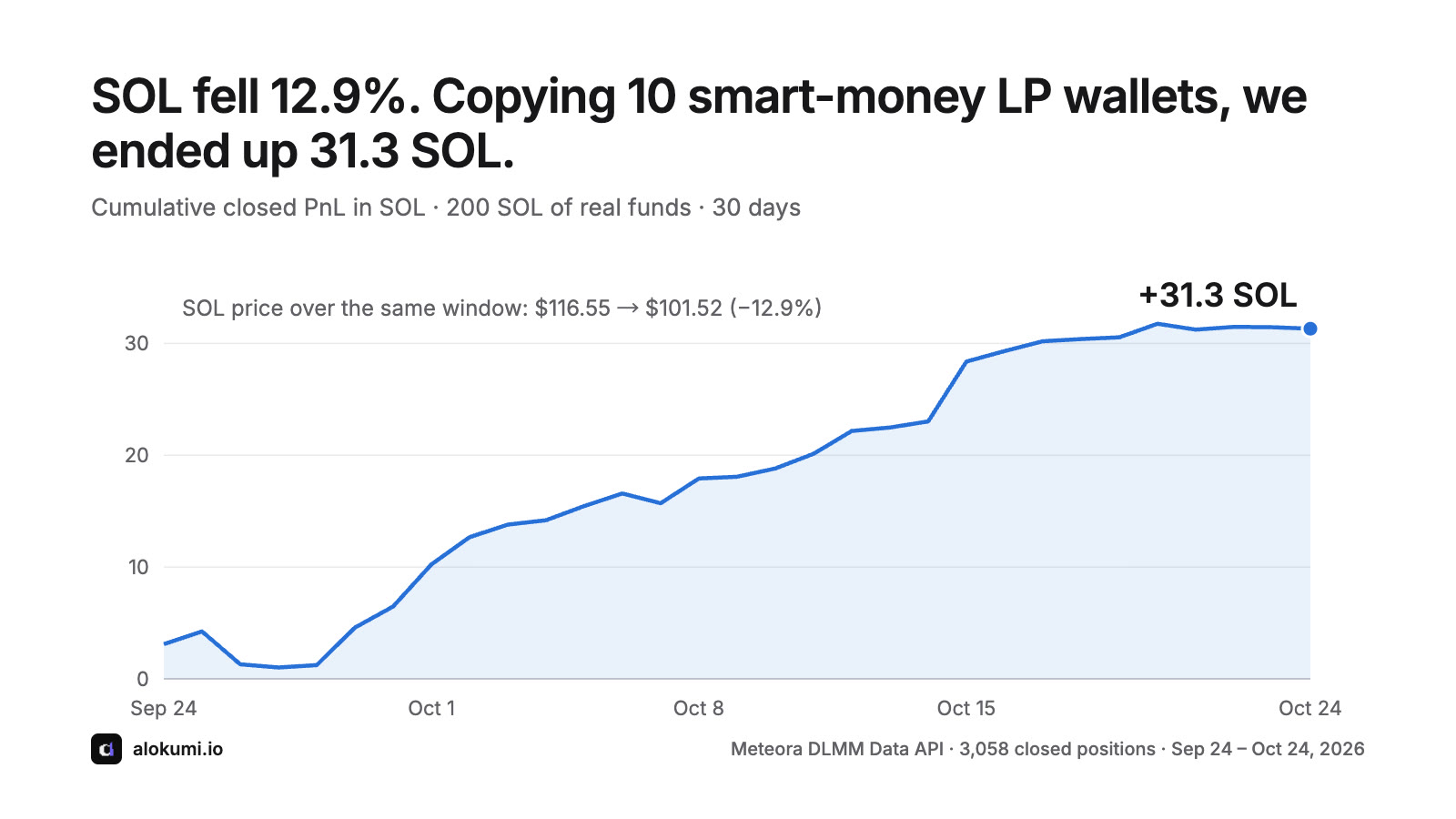
SOL fell 12.9%. Copying 10 smart-money LP wallets for 30 days, we ended up 31.3 SOL.
Real funds, 200 SOL, 30 days, 3,058 closed positions. We earned 97.7 SOL in fees and kept 31.3 of it. Here is where the rest went, from Meteora's own data.
The short version
- We copied 10 smart-money LP wallets on Meteora DLMM from Sep 24 to Oct 24, 2026, with 200 SOL of real funds.
- We ended up +31.3 SOL across 3,058 closed positions, while SOL itself fell 12.9%. In dollars that is +$2,738.
- We earned 97.7 SOL in LP fees and lost 66.4 SOL to price moves on the tokens we ended up holding.
- The median position lasted 12 minutes. Positions held 4 to 12 hours earned the most fees and kept only 5% of them.
- One of the 8 copy wallets that traded made 63% of the net profit. Two lost money. Who you copy matters more than how you copy.
The setup
Ten smart-money LP wallets on Meteora DLMM, copied with 200 SOL (about $23,300 at the start of the window). When a leader opened a position we opened the same pool and range; when they exited, we exited. It ran on the same copy engine that powers Alokumi's Copy Agent.
We measure in SOL because most of these pools are quoted in SOL and the capital started as SOL. SOL went from $116.55 to $101.52 over the window, so a dollar figure mixes the LP result with SOL's own drop. Dollar numbers are given alongside.
This is what the month looked like on metlex.io:
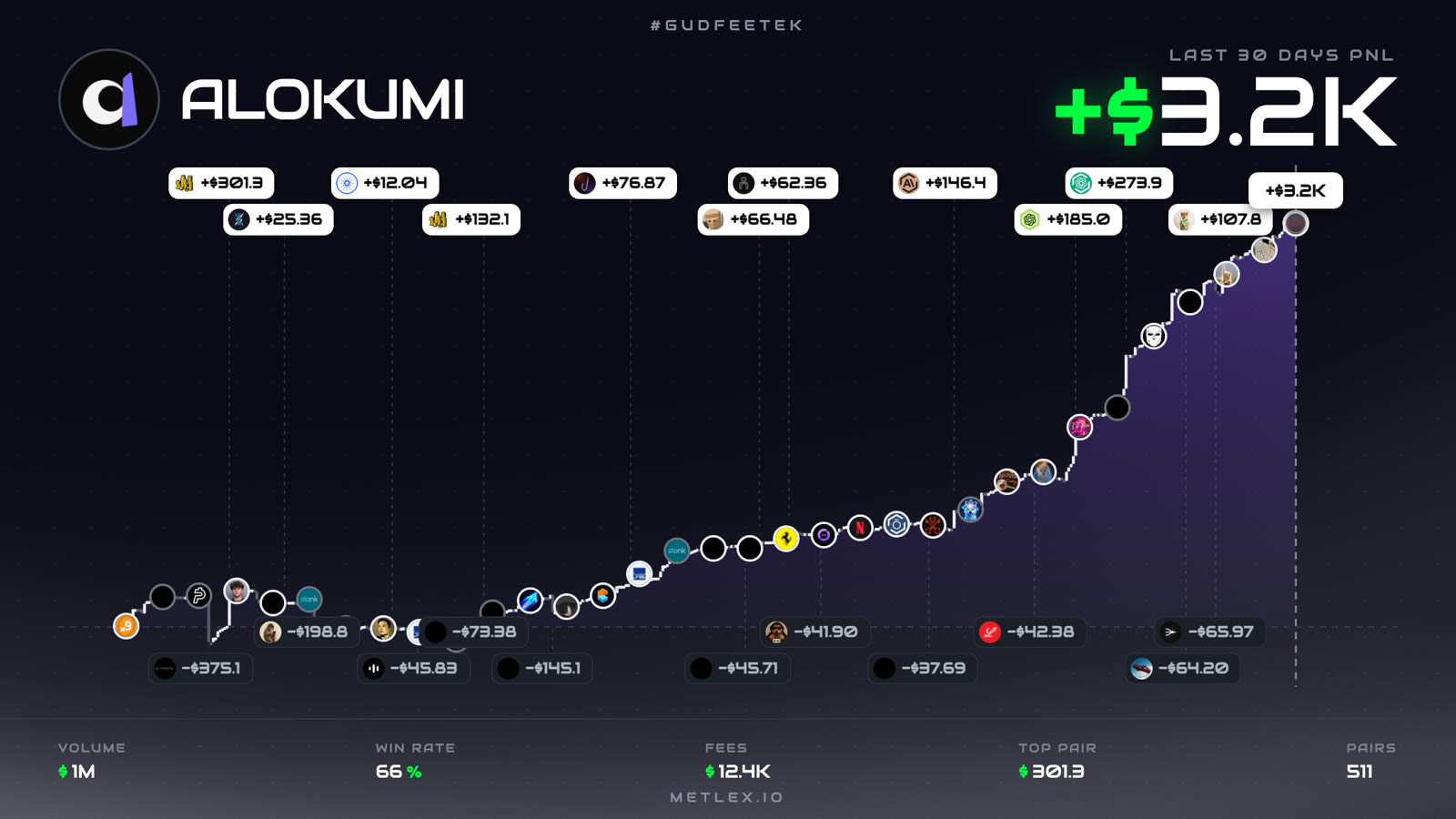
Everything else here uses only positions that were opened and closed, pulled position by position from Meteora's public Data API, so every number can be checked one position at a time.
Where the other 66 SOL went
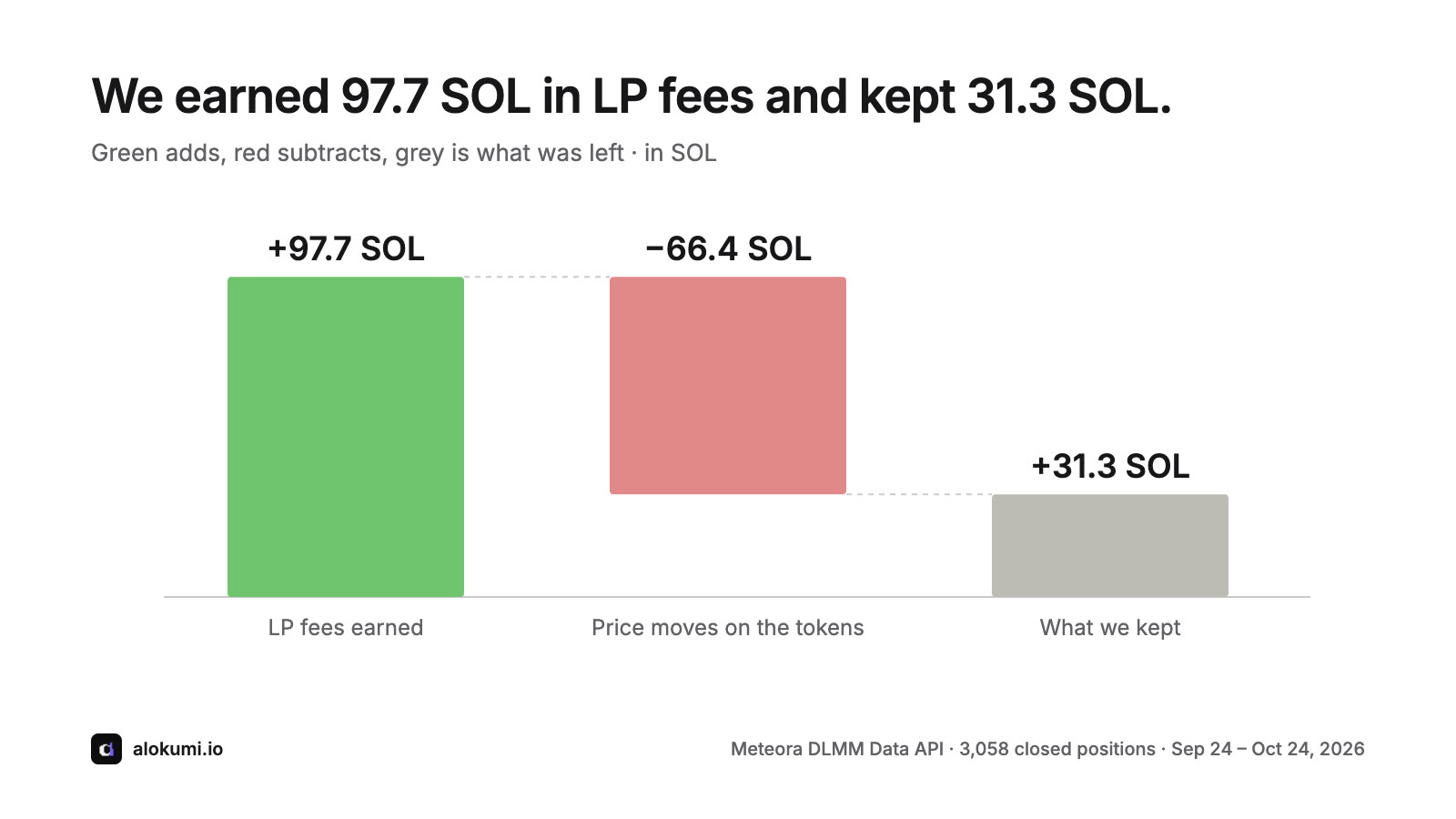
Fees were never the problem. The problem is what a DLMM range does when price falls through it: it sells your SOL for the token on the way down. We went into these positions 97% in SOL and USDC and came out holding 10% tokens. Those tokens were, almost by definition, the ones that had just gone down.
The clearest sign: 849 positions earned fees and still closed red. Together they earned 21.2 SOL in fees and lost 57.4 SOL on price. While they were open, every one of them looked like a winner on fees alone.
If you want the mechanics behind this, our guide to how DLMM bins, bin step and fees work walks through why a range converts into the falling token.
The 4 to 12 hour trap
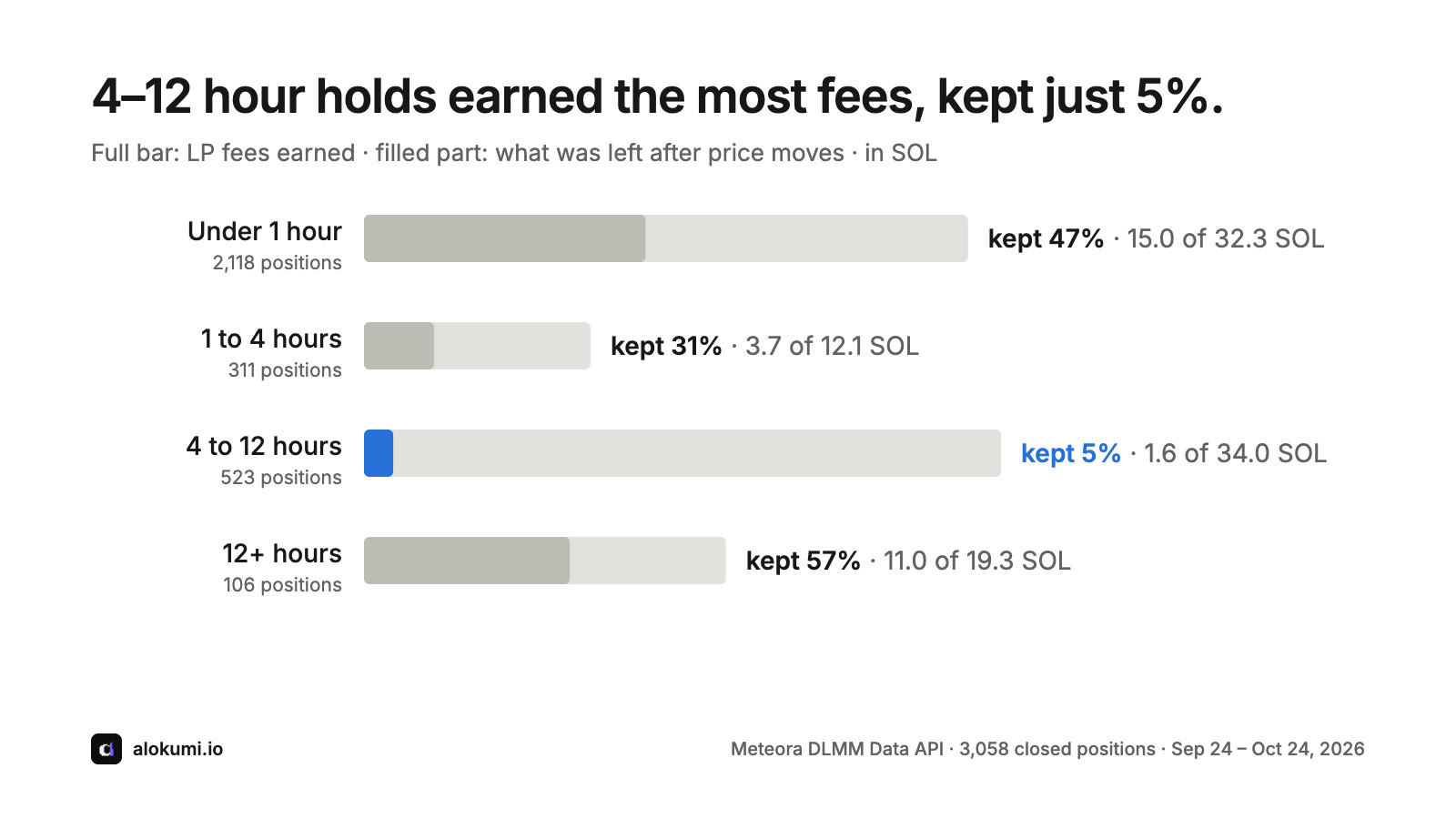
These leaders move fast. The median position lasted 12 minutes, and 69% of positions were closed within an hour. Those short holds kept 15.0 SOL, 47% of the fees they earned.
The surprise was the middle. Positions held 4 to 12 hours earned 34.0 SOL in fees, more than any other bucket, and kept 1.6 SOL, just 5%. In dollars that bucket closed at -$116. Four to twelve hours is long enough for a meme token to finish its move, and not long enough for fees to earn it back.
For a copier this cuts both ways. You can't hold less than the leader, but every second of exit delay is spent inside the part of the move that hurts.
Who you copy matters more than how
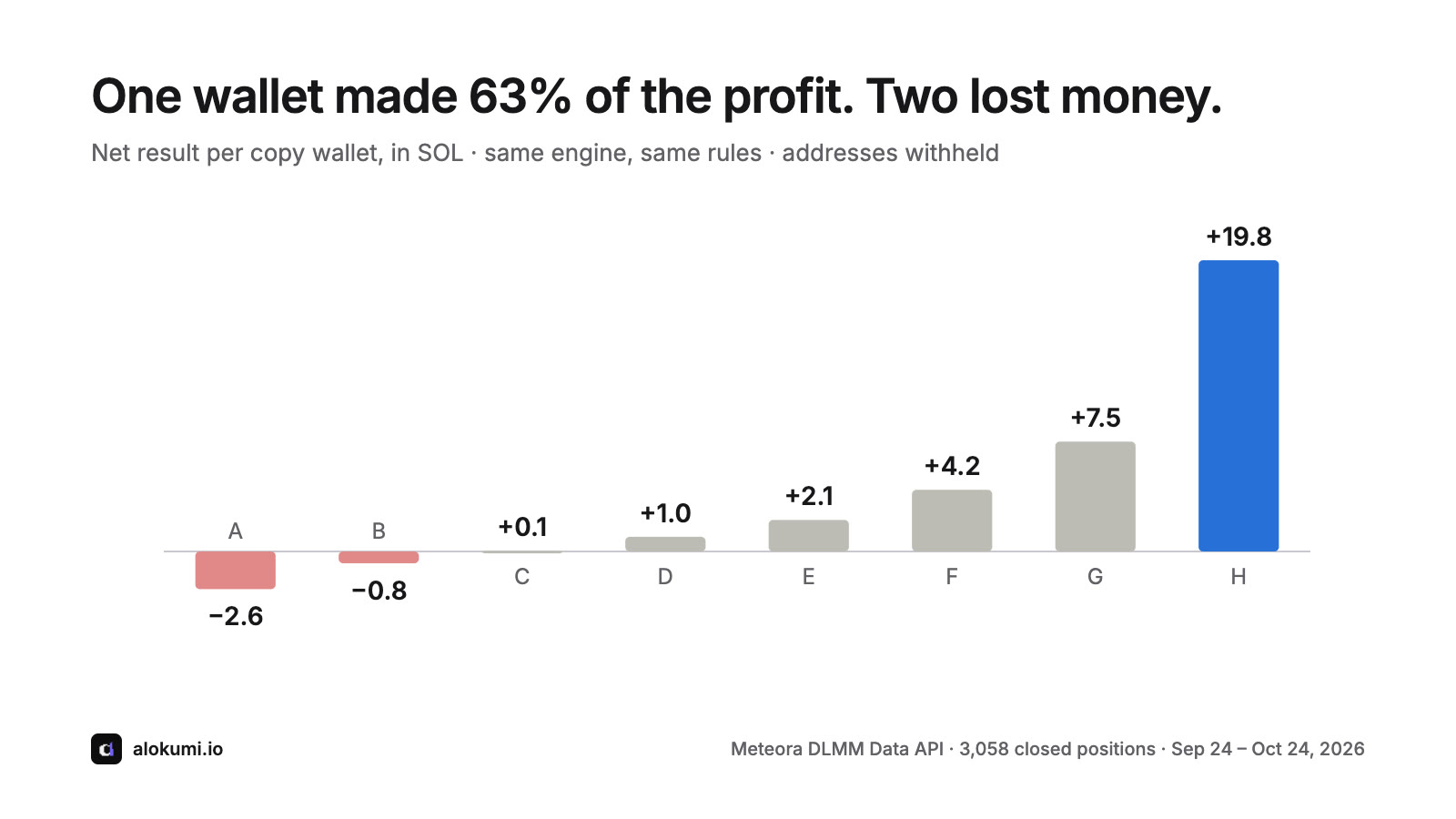
Eight copy wallets traded during the window, all on the same engine with the same rules. Their results ranged from -2.6 SOL to +19.8 SOL. One wallet made 63% of the net profit; two lost money.
The best pools were concentrated in a few themes (AI-named tokens like SI, tOpenAI and ANTHROPIC were the top three), and the worst single pool lost 3.1 SOL over five positions, four of which lasted under 20 minutes. No exit is fast enough for a token that gaps straight down.
That's the case for judging a leader by what a copier keeps, not by their fee APR or win rate. It's also why our smart-money leaderboard ranks wallets on realized PnL and fees, and flags how copyable each one is.
Red days
Six of the 31 days closed red in SOL terms. The worst day was -2.9 SOL, and the deepest drawdown in cumulative closed PnL was -3.2 SOL. Small next to the fees, but real, and that was in a month where the copied wallets did well overall.
This is one month, one set of leaders and a falling SOL market. It is not a forecast, and a different month could easily end below zero.
What we'd do differently
- Exit speed matters more than entry. Most of the damage happened while a falling token walked through the range.
- Watch the 4 to 12 hour holds. That is where fee income looks best and the least of it survives.
- Judge leaders by what you keep. Fee APR and win rate both looked fine on wallets that lost money.
- Cap each pool. One gap-down token can erase a day of fees.
- Expect red days and size so that a -3 SOL day is boring.
If you want to try copying with these limits built in, a Copy Agent runs on paper funds first, with real Jupiter quotes and real fee accounting, so you can see what you would have kept before using real money. Our Vault has not had an external audit yet. Read Risks and fees first. Nothing here is financial advice.
Method
- Source: Meteora DLMM Data API, per-position deposits, withdrawals and fees, valued in SOL and USD at the time of each event.
- Window: positions closed between Sep 24, 2026 00:00 UTC and Oct 25, 2026 00:00 UTC. 3,058 positions, 394 pools, 291 pairs, 8 copy wallets with activity.
- Net result per position = withdrawals + fees - deposits. "Price moves" = withdrawals - deposits.
- Totals in dollars: fees $11,269, price moves -$8,531, net +$2,738.
- Wallet addresses are left out on purpose. SOL price: $116.55 on Sep 24, $101.52 on Oct 24 (CoinGecko).